How to Run a Rental Business From Your Garage (Without Losing Your Mind)
A practical, no-jargon guide for anyone who accidentally started renting out gear and is now buried in sticky notes
You didn't set out to start a business. You just had a bunch of camping gear, or party chairs, or a spare camera, and someone offered to pay you to borrow it. Now it's happening every weekend and you're tracking it all in your head. Here's how to get ahead of it.
Most rental businesses don't start with a business plan. They start with one favor for a neighbor, then a friend of a friend, then a Facebook post that got way more replies than expected. If that's you — congratulations, you have a business now, whether you meant to or not.
The good news: you don't need enterprise software or a warehouse to run this well. You need a handful of simple habits. Here's where to start.
1. Know what you actually have
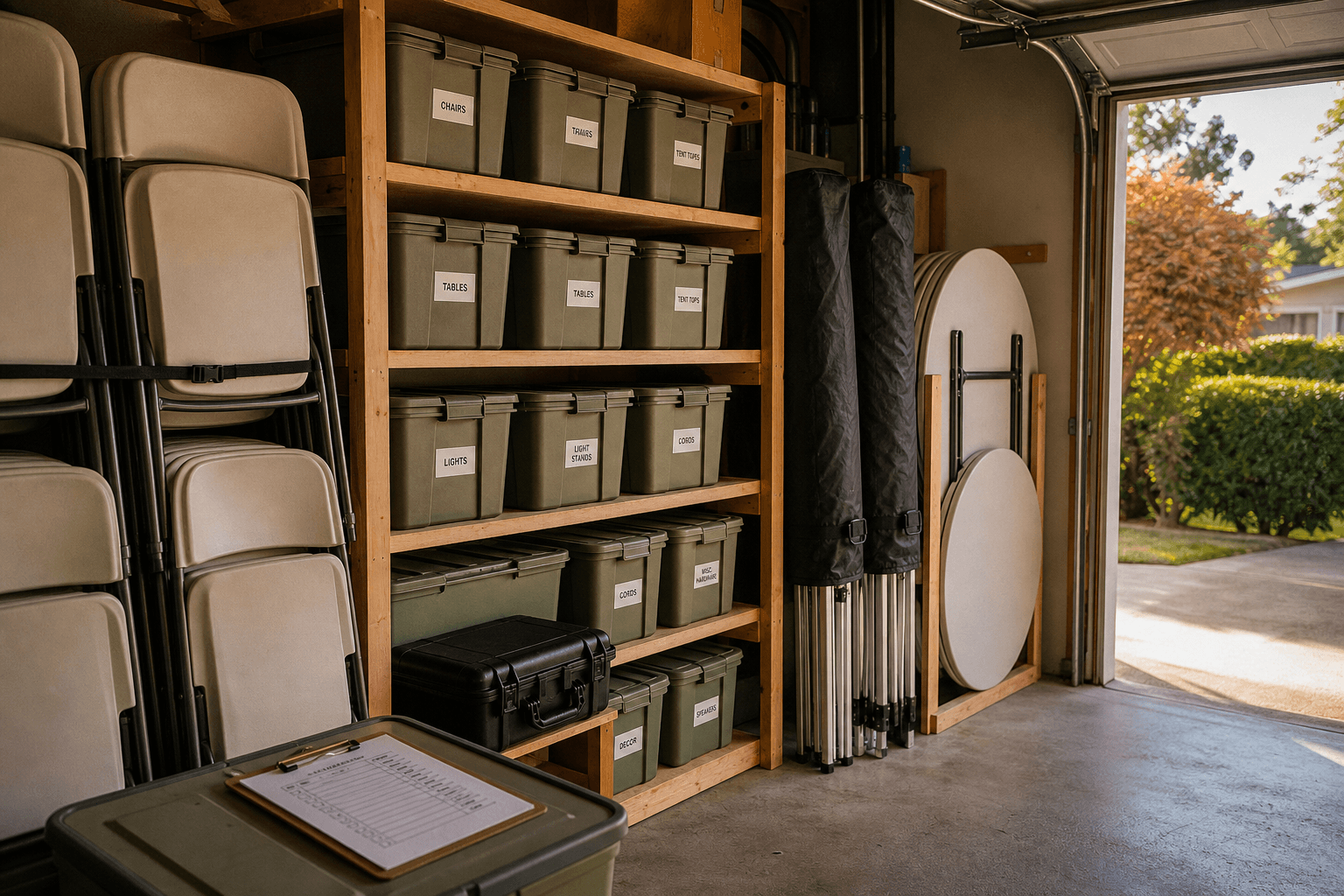
This sounds obvious until you're standing in your garage at 11pm trying to remember if you have three or four folding tables. The fix is boring but it works: give every item a name, a number, and a home.
- Label everything. A strip of gaffer tape with "TABLE-03" written on it is enough. You're not going for pretty, you're going for "I can find this in the dark."
- Group by type, not by order. All the tents together, all the tripods together. Don't organize by "stuff going out Saturday" — that setup falls apart the second a booking changes.
- Write down quantities somewhere that isn't your memory. A notebook, a spreadsheet, whatever. "5 of 20 available" is a sentence you should always be able to answer without walking outside.
The goal isn't a perfect system. It's being able to answer "do I have this available on Friday?" in under ten seconds.
2. Stop booking from memory
Double-booking is the single most common way this kind of business gets embarrassing. It usually happens the same way: someone texts you, you say "yeah should be fine," and you mean to write it down later. Later doesn't always come.
You don't need anything fancy here — you need one single source of truth. Pick one:
- A shared calendar (Google Calendar works fine) where every booking gets an entry the second it's confirmed, not after.
- A simple spreadsheet with columns for item, customer, pickup date, return date.
The rule that actually matters: nothing gets confirmed to a customer until it's written down. Not "I'll add it tonight." Right then, while you're on the phone. That five-second habit prevents most of the chaos.
3. Track condition, or your margins will quietly disappear
This is the one people skip because it feels like extra admin — and it's the one that costs the most money over time. A tripod leg gets a little bent. A tent pole cracks. A chair comes back with a wobble it didn't have before. None of it is dramatic enough to notice in the moment, but it adds up, and eventually you're renting out gear that's worth less than what you're charging for it.
A simple habit fixes most of this:
- Take a quick photo of higher-value items before they go out and when they come back. You don't need a studio shot, just enough to compare.
- Do a 30-second check at return, not "whenever you get to it." Damage is easiest to spot — and easiest to attribute to the right customer — right when it comes back.
- Keep a running note per item: "small scuff, still fine" or "zipper sticking, watch this one." It doesn't need to be formal, it just needs to exist somewhere other than your memory.
4. Decide your deposit policy once, then stick to it
Nothing eats your energy faster than negotiating the deposit fresh with every single customer. Decide the rule once, in a calm moment, and apply it the same way every time.
A few things worth deciding up front:
- Flat or percentage? A flat deposit (say, a fixed amount per item) is simpler to explain than "20% of rental value," especially over text.
- Cash, transfer, or hold? Some operators take a card hold instead of cash upfront — worth considering if you're dealing with higher-value gear.
- When does it come back? Same day as return, once condition is checked, is usually the fairest and least stressful answer for both sides.
Whatever you land on, write it down somewhere you can point a customer to. "That's just our policy" is a much easier sentence to say than making the case fresh every time.
5. Pricing: day rate, weekend rate, and not underselling yourself
A lot of accidental rental businesses start by pricing based on "what feels fair" rather than what actually covers wear, storage, and your time. A couple of starting points:
- Day rate is your base. Simple, per-24-hours.
- Weekend rate should be more than one day, but less than three — most operators land around 1.5–2x the day rate for a Friday-to-Monday rental. It rewards longer bookings without giving away the extra days for free.
- Multi-day discounts can help you win longer bookings, but don't discount so much that a week-long rental barely covers what three separate day rentals would.
If you're not sure your prices are right, a decent gut check: would this rate still feel worth it if the item came back with a small scuff you have to fix? If not, it's priced too low.
6. Knowing when the notebook stops working
A notebook or spreadsheet is a genuinely good system — right up until it isn't. The signs are usually pretty clear: you've double-booked something despite your best efforts, you can't remember which customer still owes a return, or you're spending Sunday nights reconstructing the week instead of relaxing.
That's not a sign you did something wrong. It's a sign you outgrew the tool, which is a good problem to have — it means the business is actually working.
When you get to that point, Kiryo is built for exactly this stage — small operators who need to know what's rented, to whom, and when it's coming back, without switching into "enterprise software" mode. Availability, bookings, and condition notes, all in one place you can check from your phone.
No pressure to switch before you're ready — the notebook is a perfectly good system until it isn't.
Until then: label your gear, write down every booking the moment it's confirmed, check items when they come back, and price for the wear as much as the day. That's most of the job. The rest is just doing it consistently, one weekend at a time.