Late Return Policy for Equipment Hire: How to Set Fees That Actually Stick
Grace periods, daily rates, no-show charges, and the exact words to use when a customer brings your gear back late.
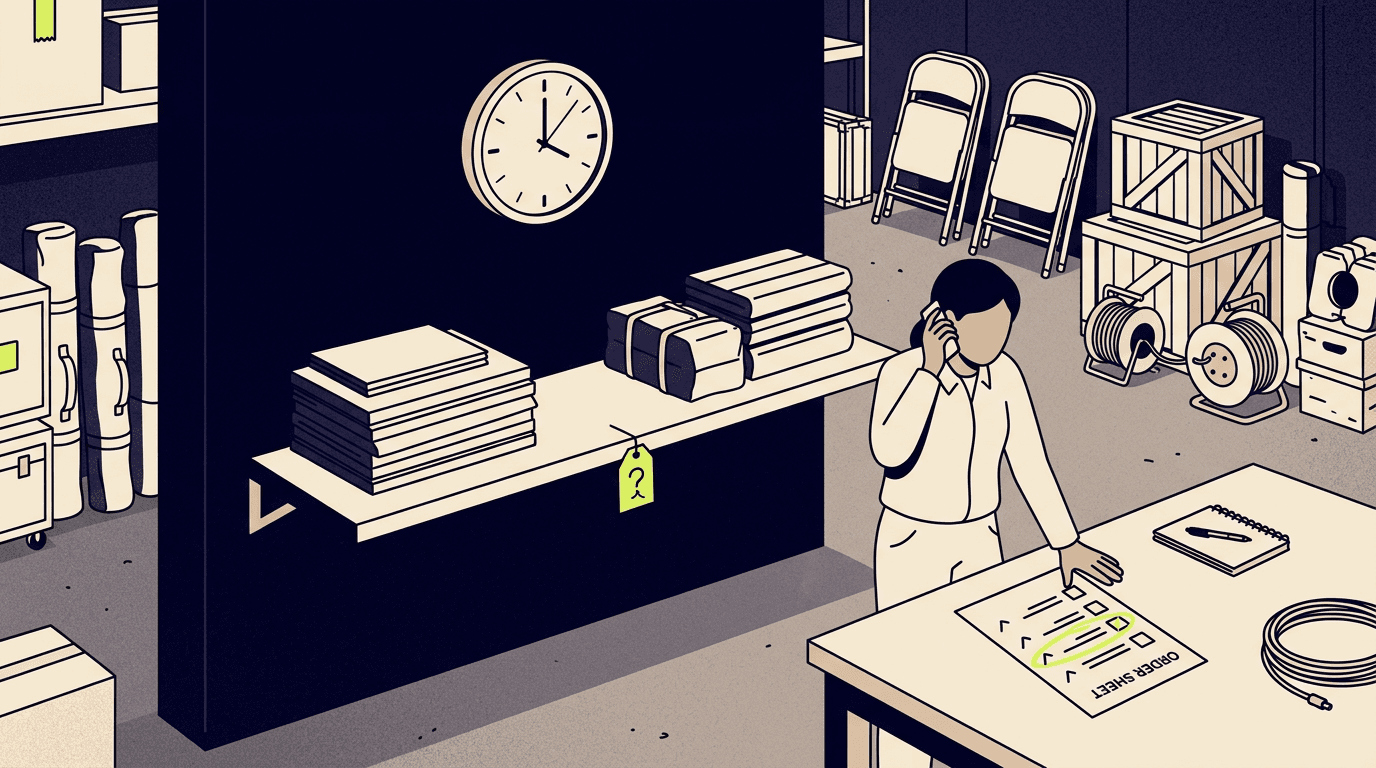
If you rent out physical equipment, whether that is party tables and chairs, camera kits, power tools, or bounce houses, a late return is never just a late return. Every extra day a customer holds your gear is a day you might have to call the next customer and tell them their order is not available. A clear late return policy for equipment rental stops that chain reaction before it starts. It also saves you from the awkward moment where you are chasing someone down over WhatsApp trying to sound firm but friendly at the same time.
Most small operators start without a written policy. Things run on goodwill and verbal reminders. That works until it doesn't. This guide walks through how to build a late return and no-show policy you can actually enforce, what to charge, and how to bring it up without torching the relationship.
A late return is not a minor inconvenience.
When someone keeps your 10-foot tent an extra two days, it's not just about the tent. It's about the wedding booked for Saturday that now has no tent. You either scramble to find a replacement, apologize to a customer who did nothing wrong, or both. Late returns create a domino effect across your calendar that a small operation, often one or two people working out of a garage or warehouse, cannot absorb.
Late returns also cost you money you will likely never recover. You spent time following up, rearranging bookings, and possibly turning away new orders because your availability looked spoken for. Even if the gear comes back fine, those hours and lost bookings are real.
Grace period, daily rate, or flat fee
There are three common ways to structure late fees for equipment hire. Most operators end up using a combination.
Grace period. Give customers a short window, usually two to four hours past the agreed return time, before any fee kicks in. This handles traffic, honest mistakes, and the customer who is running 30 minutes behind. It also makes you look reasonable if there is ever a dispute. A grace period costs you very little when the next booking does not start the same day.
Daily late rate. After the grace period, charge for each additional day. A common approach: 100% of the daily hire rate per extra day. If someone rented a pressure washer at $45/day and returns it two days late, that is $90 added to their bill. This is simple for the customer to understand and simple for you to calculate. Some operators charge 150% of the daily rate to create a stronger incentive to return on time, but 100% is easier to defend in a conversation.
Flat late fee. A fixed charge, say $25 or $50, applied once regardless of how late the return is. This works better for low-value, short-duration hires where a daily rate would feel disproportionate. If you rent out costume accessories at $15 each for a weekend, charging $15/day late fees will irritate people fast. A flat $20 late fee is simpler and feels more proportional.
Pick the structure that matches your typical booking. High-value equipment with back-to-back bookings? Daily rate. Smaller items with looser schedules? Flat fee. Either way, put a number on it. "A late fee may apply" is not a policy. "$40 per day after a 4-hour grace period" is a policy.
Write it down and put it where customers will actually see it
A late return policy only works if the customer knew about it before they picked up the gear. This does not require a 10-page contract. A few clear sentences on your booking confirmation, your rental agreement, or your quote document will do.
Here is an example you can adapt:
Late returns: Equipment is due back by the date and time listed on your order. There is a 4-hour grace period. After that, a late fee of $[amount] per day applies until the items are returned. If a late return causes us to cancel or delay another customer's booking, the full hire rate for those affected days will be charged.
No-shows: If you do not pick up your order and do not contact us within 24 hours of the scheduled pickup time, the booking may be cancelled and a no-show fee of $[amount] or [percentage]% of the order total will apply. The reserved dates will be released for other bookings.
Send this with the booking confirmation, not buried at the bottom of a PDF nobody reads. If you take a deposit, make the policy visible before the deposit is paid. That way, when you need to enforce it, you are not introducing something new. You are referring back to something they already agreed to.
No-shows at pickup: how long to wait and what to charge
A customer who never shows up to collect their order is a different problem from a late return, but it hurts the same way. You held that inventory off the calendar. You might have turned away another booking for those dates. The gear sat in your warehouse tagged and ready, and nobody came for it.
Decide in advance how long you will wait before treating it as a no-show. A reasonable approach: try to reach the customer by phone or message at the scheduled pickup time. If you have not heard back within 24 hours, cancel the booking and release the dates. Charge a no-show fee, either a flat amount or a percentage of the order total. Something in the range of 25% to 50% of the total is common. The deposit, if you collected one, typically covers this.
The key is releasing the dates quickly. Every day you hold equipment for someone who isn't responding is a day that inventory is unavailable to paying customers.
Send a reminder before the return is due
The single most effective thing you can do to reduce late returns is to remind customers before the due date. A short message the day before, something like "Just a reminder, your order is due back tomorrow by 5 PM," solves most lateness before it happens. People forget. They lose track of dates. A quick nudge the day before fixes that for free.
If you are managing more than a handful of active orders, sending these reminders manually gets old fast. Even a recurring calendar reminder to yourself, "check what is due back tomorrow and message those customers," is better than nothing.
Having the conversation when someone is already late
The policy exists so this conversation does not have to start from scratch. When a customer is late, you are not inventing a penalty on the spot. You are applying what was agreed.
Here is what that sounds like in practice. Say you rent out event lighting and a customer was supposed to return a set of festoon lights yesterday morning:
"Hi Sarah, just checking in. The festoon lights were due back yesterday by 10 AM. We have a 4-hour grace period on returns, so the late fee started from 2 PM yesterday. Our rate is $30 per day, same as on the booking confirmation. Could you let me know when you are able to drop them off? I have another booking for those lights this Friday, so sooner is better."
Notice what this message does. It states the fact without blame. It references the policy and where the customer saw it. It names the specific fee. And it gives a practical reason to return soon, the next booking, without making it a threat. Most customers respond well to this. They forgot, or the event ran long, and they will bring the gear back that day.
If someone pushes back, keep it factual: "I understand, and I appreciate you getting back to me. The late fee is part of our standard terms because we often have back-to-back bookings on the same equipment. I can't waive it this time, but let's get the lights back and we'll sort out the final balance."
When to waive a fee without setting a bad precedent
Sometimes you should waive a late fee. A long-time customer who has never been late before and returns the gear six hours past the grace period? That is a reasonable moment to show goodwill. A first-time customer who communicates proactively and returns everything the next morning? Also fair.
The trick is how you frame it. Never say "don't worry about it" as if the fee does not exist. Instead, try: "I'm going to waive the late fee this time since you let me know right away and got everything back quickly. Just keep the return time in mind for next time." This tells the customer three things: the fee is real, you chose to waive it as an exception, and it will apply next time. You are being generous without rewriting the rules.
If the same customer is late a second time, enforce the fee. You already gave them the exception once, and they know the policy. No guilt required.
Put the policy to work
A late return policy for equipment hire does not need to be long or complicated. It needs to be written down, visible before the customer pays, and applied consistently. Grace period, a clear rate, and a no-show clause cover most situations. Reminders before the due date prevent most problems. And when something does come back late, a short, factual message referencing the policy keeps the conversation professional.
If you are tracking orders across a spreadsheet or a group chat, spotting what is overdue and who needs a reminder takes effort you could skip. Tools like Kiryo flag overdue items on your dashboard and let you send return reminders directly, so nothing slips through because you were busy loading a van.