Rental Delivery Scheduling for One-Person Equipment Operations: Stop Running Back and Forth All Day
A practical guide to batching deliveries and pickups by area and time window so you spend less time driving and more time running your business.
A practical guide to batching deliveries and pickups by area and time window so you spend less time driving and more time running your business.
When you're renting out tables, tents, tools, or any physical equipment from a garage or small warehouse, deliveries and pickups eat more time than anything else. And if you're a one-person operation handling all of it yourself, rental delivery scheduling is probably the thing you think about least. You load the van, drive where you need to go, come back, load the next batch, and do it again. That works fine with two or three drops in a day. It stops working fast.
Why "I'll just fit it in whenever" breaks down
Most solo operators start by delivering in roughly the sequence orders came in. That feels fair, and it's simple enough with a couple of stops. But once you're doing four or five drops, the booking sequence has nothing to do with where customers actually are on the map. You end up driving twenty minutes north, forty minutes south, then back north for a pickup. By mid-afternoon you've burned half a tank of fuel and you still have three stops left.
On a busy weekend, this turns into pure chaos. You're running late for every stop, making promises you can't keep, and by Sunday night you still haven't picked up the gear that was supposed to come back Saturday. That costs you fuel, time, and the trust of customers who expected you at 9 AM and saw you at noon.
Better rental delivery scheduling: group by area, not booking order
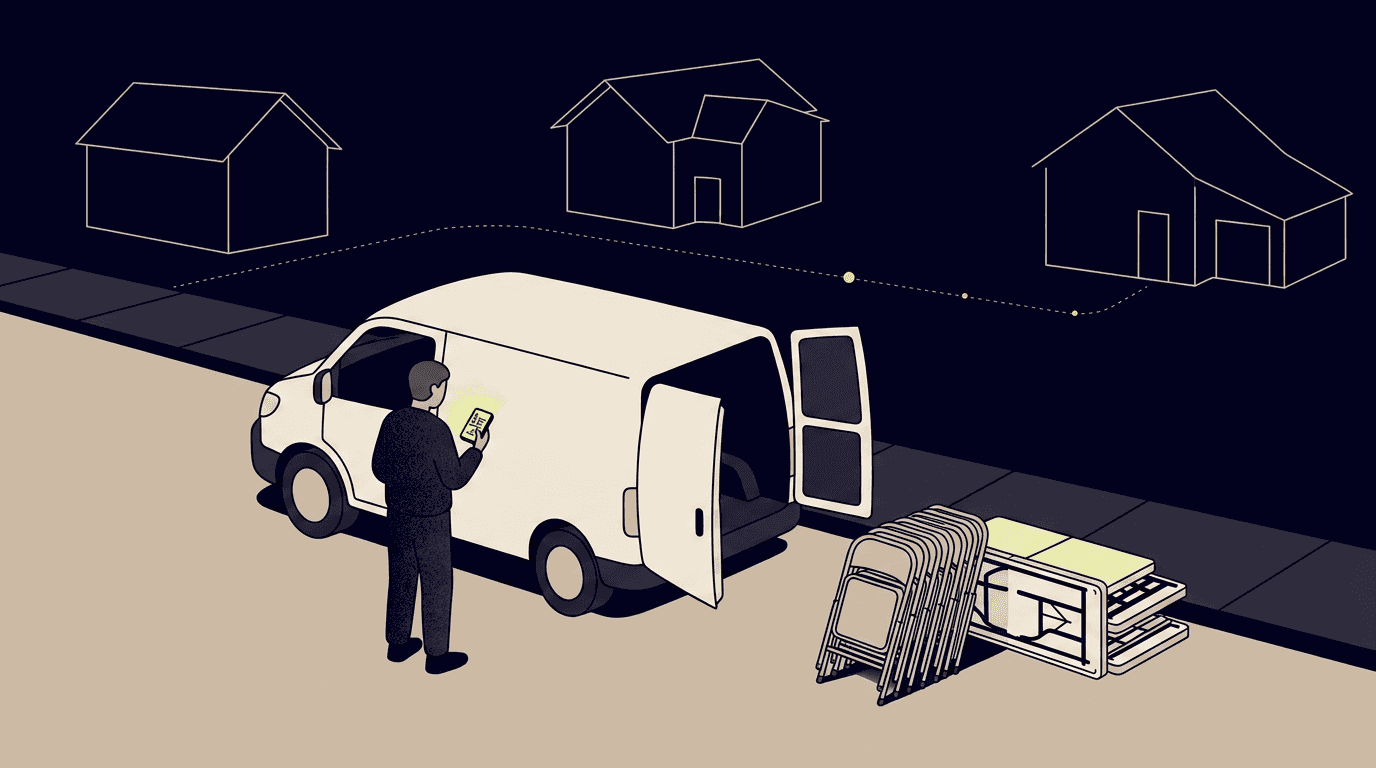
The single biggest improvement you can make is to stop scheduling deliveries in the order they were booked. Instead, look at all the drops and pickups for a given day and group them by area. Three deliveries on the east side, two on the west? Do all the east side drops in one run, all the west side in another. It takes planning the night before or first thing in the morning, and that's the step most people skip.
Layer in pickups too. If you're delivering party equipment to a venue on the east side at 10 AM and there's a pickup due from another customer fifteen minutes away, do them back to back. That second trip across town just disappeared.
Give each zone a time window, not an exact time. "Between 9 and 11 AM" is honest and doable. "I'll be there at 9:15" sets you up to fail the moment one stop takes longer than expected.
Lock everything down before you leave the warehouse
Nothing worse than being twenty minutes into your route and realizing you forgot to load something, or that a customer gave you a gate code two weeks ago and you can't find the message. Small problems individually. They stack up fast when you're on the road.
Before you pull out of the driveway, you need a few things confirmed for every single stop:
- What's loaded. Check it against the order, not from memory. If a customer ordered 10 folding chairs and a canopy, count them. Thirty seconds now saves you a return trip later.
- Who's expecting you and when. A name and a time window for every stop. Not just "the birthday party on Oak Street."
- A backup contact for each stop. If nobody answers the door or the gate is locked, who do you call? Get this before you leave, not while standing outside a locked venue.
- What happens if no one's there. Can you leave the equipment at the side door? Does the customer want you to call and come back? Sort this out ahead of time.
Write it down, print it, pull it up on your phone. The format doesn't matter. What matters is you're not figuring out basic logistics while driving.
Setting realistic ETAs without living on your phone
Customers want to know when their stuff is showing up. But if you're the one driving, loading, and texting updates, you'll spend the whole day on your phone instead of getting things delivered.
What works: send one message per customer, early in the day, with a time window. "Your tables and linens are on the truck, I'll be at your location between 10 AM and noon." That's it. No live GPS updates. Just a window they can plan around and enough breathing room for you when one stop runs long.
If you're running significantly late, send one short update. "Running about 30 minutes behind, closer to 12:30." People are almost always fine with a delay as long as they're not left guessing. The silence is what frustrates customers, not the late arrival.
Batch these messages. Send all your ETAs at once in the morning while you're still at the warehouse, before you start driving.
Treat pickups with the same discipline as deliveries
Deliveries get the planning because there's a clear deadline: the customer needs their gear before the event. Pickups tend to get treated as an afterthought. "I'll swing by and grab it sometime." That's how you end up with a tent still sitting in someone's backyard three days after the party ended.
Pickups need the same routing logic. Group them by area, assign a time window, confirm that someone will be there or that you can collect the gear from a specific spot. Have a plan for when the customer isn't home, just like you do for deliveries.
This matters even more when the same items are booked for another customer the next day. If you don't pick up 20 folding chairs Saturday evening, you can't deliver them Sunday morning. Every late pickup creates a downstream problem that's harder to fix than prevent.
A simple routine for busy weekends
Weekends are when most equipment rental operators are busiest and when the delivery schedule is most likely to fall apart. A simple routine keeps it manageable:
Thursday evening or Friday morning: Look at everything that's going out Saturday and everything that's due back. Map out your zones. Figure out what can be combined. Set your time windows.
Friday evening: Pre-load what you can. If Saturday morning deliveries are confirmed, get the van packed the night before. Check items against orders. Top off the fuel.
Saturday morning before you leave: Send all your ETA messages at once. Confirm you have backup contacts. Check the route one more time.
Saturday evening: Do your pickup run while everything is still accessible. Don't push it to Sunday unless the customer specifically asked. The sooner gear is back, the sooner you can clean it and know what's available for next week.
Sunday: Handle remaining pickups and returns that came back dirty or damaged. Log condition issues while they're fresh, not three days later when you can't remember which customer had the stained tablecloths.
This isn't complicated. It's just a habit. The operators who do it consistently are the ones who stop dreading weekends.
Keeping track of it all
You can do all of this with a notebook and a map app. But once you're past a handful of orders per week, the mental load of tracking what's going where and what's due back starts to pile up. That's where a purpose-built tool helps. Kiryo is built for this kind of operation: tracking what's out, what's due back, and keeping delivery details in one place so you're not digging through text messages at a red light.
Tool or no tool, the core of good delivery scheduling for equipment rentals is the same: group by area, lock down details before you leave, give honest time windows, and treat pickups like they matter as much as deliveries. Do that consistently and your weekends get a lot less chaotic.